
3 July, the Day of Responding to the Popular Will
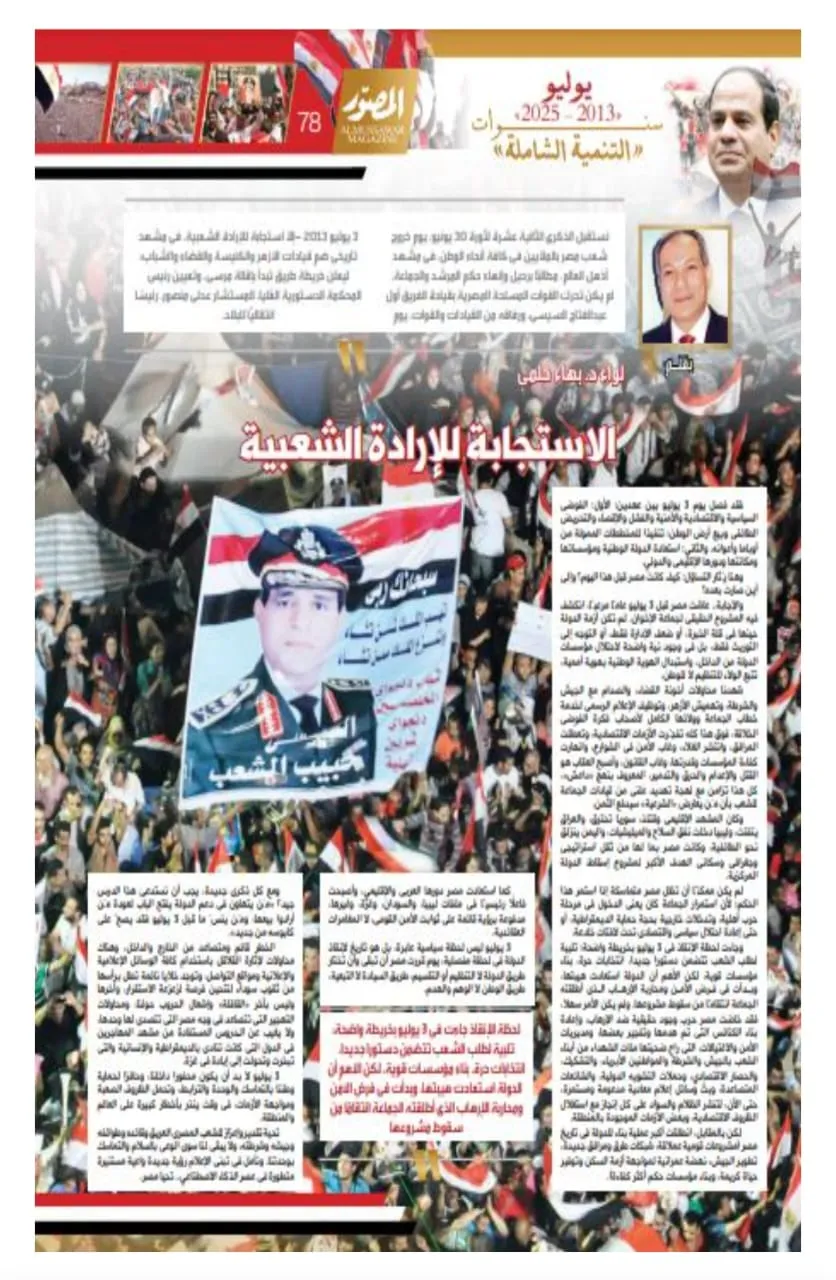
The move by the Egyptian Armed Forces, led by Colonel General Abdel Fattah El-Sisi and his fellow commanders and forces, on 3 July 2013 was nothing but a response to the popular will, in a historic scene that brought together the leaders of Al-Azhar, the Church, the judiciary and the youth, to announce a road map beginning with the removal of Morsi and the appointment of the President of the Supreme Constitutional Court, Counsellor Adly Mansour, as interim president of the country. The day of 3 July separated two eras: the first, political, economic and security chaos, failure, exclusion, sectarian incitement and the selling of the homeland’s land, in implementation of the plans funded by Obama and his helpers; and the second, the restoration of the national state and its institutions, its standing and its regional and international role. Here the question arises: what was Egypt like before this day? And where has it gone since? The answer.. Before 3 July Egypt lived a terrifying year in which the real project of the Muslim Brotherhood was exposed. The crisis of the state at the time was not only lack of experience, weak management or the move towards hereditary succession, but a clear intention to occupy state institutions from within and replace the national identity with a transnational identity based on loyalty to the organization, not to the homeland. We witnessed attempts to Brotherhood-ize the judiciary, clashes with the army and the police, the marginalization of Al-Azhar, and the use of the official media to serve the group’s discourse and its full loyalty to the authors of the idea of creative chaos. On top of all this, economic crises erupted, utilities broke down, prices soared, security disappeared from the streets, the efficiency and capacity of institutions collapsed, the law was absent, and punishment became killing, execution, burning and destruction, known as the ISIS method; all this coincided with a tone of open threat from the group’s leaders to the people that whoever opposed “legitimacy” would pay the price. The regional scene at the time was this: Syria burning, Iraq disintegrating, Libya entering the tunnel of weapons and militias, Yemen sliding towards sectarianism, and Egypt, with its strategic, geographic and demographic weight, the greatest target of the project to bring down the central state. Egypt could not have remained cohesive had this rule continued. Because the continuation of the group meant entering a stage of civil war and foreign interventions on the pretext of protecting democracy, or even political and economic re-occupation under deceptive banners. The moment of rescue came on 3 July with a clear road map; in response to the people’s demand, it included (a new constitution – free elections – the building of strong institutions). But most importantly, the state regained its prestige and began to impose security and fight the terrorism that the group unleashed in revenge for the fall of its project. It was not easy: Egypt fought a real war of existence against terrorism, rebuilt the churches that had been demolished and some of them blown up, and the security directorates, and faced the assassinations that claimed hundreds of martyrs from among the people in the army, the police and innocent citizens, the doubt-mongering, the economic siege, the international smear campaigns, the escalating rumours, and the broadcasts of hostile media “supported and continuing until now” to spread darkness and blackness over every achievement, exploiting the economic circumstances and some of the crises in the region. But on the other hand, the largest state-building operation in Egypt’s history was launched (giant national projects, new road and utility networks, the development of the army, an urban renaissance to confront the housing crisis and provide a decent life, and the building of more efficient governing institutions). Egypt also regained its regional role and became a main actor in the files of Libya, Sudan, Gaza and others, driven by a vision based on the constants of national security, not ideological adventures. 3 July is not a passing political moment, but a date for saving the state at a pivotal moment, the day Egypt decided to remain and to choose the path of the state, not of the organization or partition, the path of sovereignty, not dependency, the path of the homeland, not illusion and destruction. With every new anniversary, we must recall this lesson well: “whoever is lax in supporting the state opens the door to the return of those who wanted to sell it. And whoever forgets what came before 3 July may wake up to its nightmare again”. The danger exists and is growing from abroad and at home; there are attempts to stir up unrest using all media and advertising means and social media, and there are sleeper cells poking their heads out of black holes, waiting for an opportunity to destabilize. The latest, but not the last, is “the convoy” and the igniting of wars around us, and the attempts at displacement that are escalating in the face of Egypt, which confronts them alone; and the lessons learned from the scene of migrants in the countries that used to call for democracy and humanity, which evaporated and turned into genocide in Gaza, are not absent. 3 July must be engraved within us and be an incentive to protect our homeland through cohesion, unity and solidarity, bearing difficult circumstances and confronting crises, at a time that portends great dangers for the world and the region. A salute of appreciation and pride to the ancient Egyptian people and its leader, its communities, its army and its police; and nothing remains for us but awareness of peace and holding fast to our unity. We hope the media will adopt a new, aware, enlightened and developed vision in the age of artificial intelligence.. Long live Egypt.