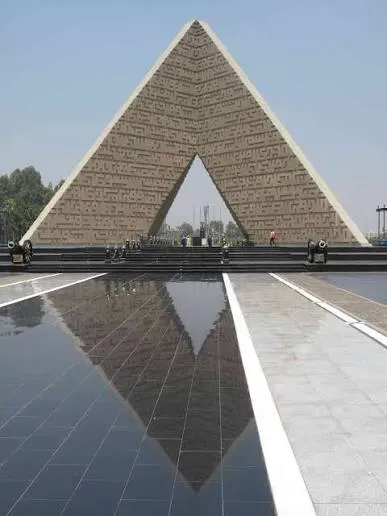
Soldiers have their monuments, and the martyrs of the police have their names engraved on walls. That is their right, and our duty. But what about the man who went out to buy bread and never came back? The worshipper who never finished his prostration? The child whose school bag was the last thing he left behind?
These people did not choose a battle, but the battle chose them. Since July 2013, many Egyptians have fallen in a wave of violence and terrorism that has struck churches, mosques, markets, roads, checkpoints, and homes. They carried no weapons, and a confrontation was the last thing on their minds, yet they became targets for those who make no distinction between a combatant and an unarmed civilian.
In the very place where a president fell to a assassin’s bullets, a different story can be written. The site of that wound can become a wall of memory, engraved with the names of the innocent citizens killed in terrorist attacks since July 2013. Names, not numbers. Numbers are forgotten in the news bulletins, but a name endures: the name of a father, a mother, a child, a worker, a student, a worshipper, whether Muslim or Christian.
The value of this monument is that it says what reports cannot: terrorism does not target the state alone, but the ordinary person in his daily sense of safety. And a nation that honors those who fell in service also owes a debt to those who fell while simply living their modest lives.
For the project to be unifying rather than divisive, it needs clear rules:
First: a defined criterion for inclusion, covering every innocent civilian killed in a terrorist act whose nature has been established by a court ruling or an official acknowledgment.
Second: a supervisory body that includes the state, civil society, representatives of Al-Azhar and the Church, and the families of the victims, so that this memory belongs to everyone.
Third: a wall able to receive any new name, though we hope that no other name will ever be added.
Fourth: an annual moment to stand and read the names aloud, so that the monument does not become a silent stone.
Nations do not heal through forgetting, but by looking into the faces of those they have lost and saying to them: You are not numbers, and your stories will not be lost. And when a child stands before this wall and asks, “Who are these people?”, he will find an answer that teaches him that the homeland protects its children, even after they are gone.
They have names, and they are not numbers. It is time for these names to be written.
