
The Talk of the Awalem
Dr. Bahaa Helmy Writes
While leafing through some daily newspapers, my attention was caught by an article in Al-Masry Al-Youm, in the issue of 26 September, entitled “A Call for Coexistence Among the Supporters of Egypt’s Revolutions in the Modern Era”, by the writer Dr. Saad Eddin Ibrahim.
The title carries a call for harmony and affection in its first part, while the other part is wrapped in ambiguity and questions.
What is meant by the supporters of Egypt’s revolutions? And how are we to classify those who supported the demands for justice in 2011 – before the Brotherhood’s intervention and their seizure of power – and then took part in 30 June 2013, demanding the rejection of the rule of the Guide and the organization? This prompted me to read the content and try to understand the ideas, creativity and philosophy of the professor who wrote the article.
But the content was even more painful, as it carries the utmost degree of intellectual contradiction and human vanity, which made the writer stand on the mountaintop like one who stood “on the brink of a crumbling bank, so it crumbled”, to talk to us about a thought marred by deviation and the distortion of facts and history together.
The writer stated that the Supreme Council for National Defence asked Dr. Mohamed Morsi to back down from his decisions and gave him a deadline, but he did not back down; therefore, after a final warning to him to step down from the presidency, the Supreme Council for National Defence intervened, removed him and arrested him.
He returned to the thread of his talk and said that after Field Marshal Abdel Fattah El-Sisi was elected President of the Republic, those moves were described as the 30 June Revolution.
He also said that the foundations of President El-Sisi’s rule and his legitimacy had succeeded.., and that the Sisi regime had given the utmost importance to armament, health and education..
The truth is that this logic and philosophy with which the writer sets down these ideas can only come from the awalem.
The doctor who wrote the article has forgotten, or chosen to forget, that the Supreme Council for National Defence moved and complied with the demands of the whole people, both those who were in the squares and streets and those who were below their homes throughout Egypt.
And that the army shouldered its responsibility in complying with the people’s demands and preserving the country’s national security.
And that the decisions to save the country from partition, discrimination and the opening of the borders were taken with the participation of the figures and representatives of the people and its various components, publicly, before the whole world.
The strangest thing in the article is “the writer’s denial of the people’s revolution of 30 June 2013”, claiming that it was the President who called it a revolution.
The writer went so far, in his imagination and his bias towards the Brotherhood, as to describe the system of government as (the Sisi regime), deliberately ignoring the historical facts that we lived through and are living together, namely that the system of government was established in accordance with the 2014 Constitution, and it is therefore the constitutional system for governing the country, not a system of government belonging to a particular person, and it may not be privatized.
Here another question arises: does Egypt’s recovery of its sovereignty over its land, its institutions and its decision from the hands of people convicted of treason against the homeland – lead the writer to apply the description of a people and supporters of a revolution to an organization that is terrorist by law.
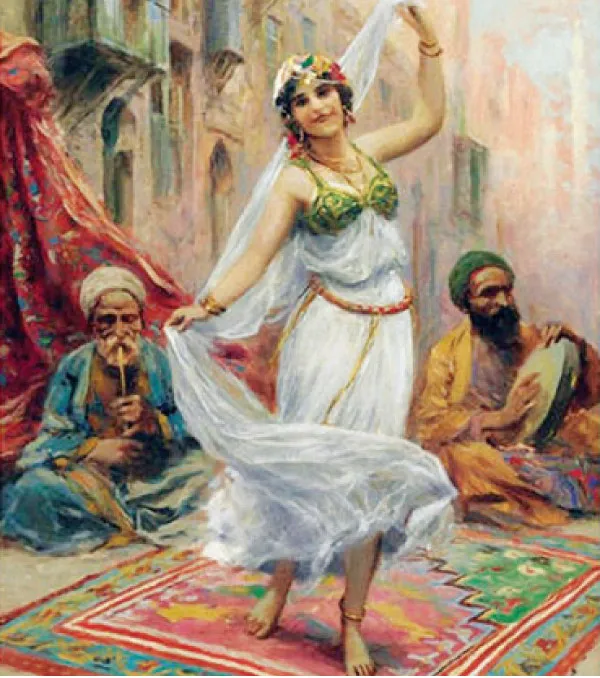
These may truly be creative and artistic philosophical ideas, like the stories of films, plays and dance, for dance is one of the forms of art in the past and the present; in the past the term awalem was applied to creative dancers, in the countryside they were known as ghawazi, some practise dance as a means of improving physical fitness and losing weight, and there is also tightrope dancing.
And since we revere, value and respect the value of knowledge and learning, and our respect and esteem increase for the great professors, especially the elderly among them. We ask God Almighty to protect everyone from the diseases of old age and to grant us a good end.
We therefore tried to search the lexicons and dictionaries for the meaning of awalem, and found it to come from ʿilm, ʿalmaniyya, maʿalim, taʿwlim. In the Hebrew language, awalem may mean signs pointing to creative life – according to the Wikipedia website – which places the doctor’s words in the ranks of the talk of the awalem.
Each one of us is responsible before God for what he sets down and writes and what he harbours within himself, and nothing will benefit him except truthfulness, honesty and a good end “mentioned earlier for emphasis”; history is the best witness to the deeds, words and writings of every person, whatever his affiliation or creativity; we pray to God to inspire us with the right path as we are on our way to leaving the earth for the abode of truth; as for the judgement of the coming generations, it will belong to history, which is documented by competent bodies that deserve all appreciation and respect.