
Violence and Thuggery in the Street
Dr. Bahaa Helmy Writes:
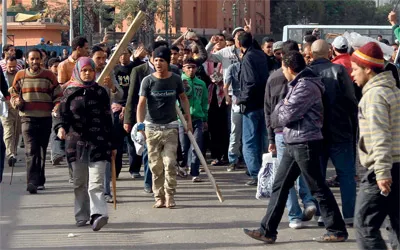
We previously wrote an article about violence in society and its causes, and we are writing again after the increase in the rates of criminal offences, represented in assaults on persons and property, acts of thuggery, kidnapping and revenge at the hands of some hired criminals acting for one party against another, or crimes committed against women and tourists such as harassment and violation of the sanctity of personal life, and other crimes of violence committed in the Egyptian street, some of which circulate on social media.
This reflects negatively on the degree of safety in society and is a direct threat to citizens, residents and tourists, in addition to the resulting bad image of society at the international level, and it affects tourism and the national income.
The tendency of some to try to obtain their rights outside the scope of the law, or to commit crimes of thuggery and impose protection money on others or on investors in some locations at the hands of some Bedouin elements.. is something that sounds the alarm and requires a decisive confrontation of the negative effect of these crimes on the security, social, economic and also political situation.
The Egyptian police have been playing an effective role in confronting crime in its various forms in the street since the 30 June Revolution, and continue their giving, the loyalty of their men and their sacrifices, the latest being the martyrdom of some security commanders after carrying out pursuit operations against some criminals in the governorates of southern Upper Egypt.
However, the increasing security burdens resulting from the growth of urban and population expansion, the increase in the number of universities and educational institutions, the expansion of investment activities and the building of factories in the new urban communities in many cities and governorates, alongside taking part in counter-terrorism operations with the valiant armed forces and securing the demolition of illegal buildings, require increasing the size and number of the police’s manpower, while providing the capabilities and equipment required to enforce the law and confront these crimes decisively in accordance with the law, arresting fugitives from judgments, tightening control and oversight over the border crossings between governorates, and reinforcing the information and criminal investigation services with police officers and personnel in proportion to the duties and tasks assigned to them.
Violence in society points to a decline in awareness and a departure from religious and social principles and values, which calls for the importance of considering harsher penalties for thuggery and violence in the street, with heavier penalties in the case of recidivism, and the speedy completion of litigation procedures to rule on those crimes so as to achieve general and specific deterrence.
There is no doubt that achieving criminal security throughout the country requires strenuous efforts and reinforcing the police forces, whether in the Central Security sector or Special Operations, as the forces entrusted with carrying out security operations against the dens of crime, the smuggling of and trafficking in drugs and prohibited goods, and other crimes that may exceed the capacities and capabilities of the local police represented by the security forces of the security directorates.
While supporting them with modern security technology, such as the use of drones in coordination with the armed forces when carrying out police operations, for filming, tracking criminals and uncovering their hiding places, whether inside cities and villages or in remote areas, in parallel with counter-terrorism tasks and operations.
Strengthening security efforts in the face of rising rates of violence and thuggery requires media support and banning films and series interspersed with scenes of violence, in order to preserve social and religious values and the role models that are among the elements shaping the awareness of young people, children and the Egyptian family, as the foundation of society whose pillars are religion, morality and patriotism, as the Constitution provides.
While urging everyone, especially professors of sociology at Egyptian universities and Muslim and Christian religious scholars and clerics, to take an active part in confronting this dangerous phenomenon in cooperation and coordination with civil society, activating the role of educational, sports and cultural institutions in developing awareness among Egyptian families throughout the Republic, and supporting poor families with micro-projects that generate income to increase earnings and employment, with their commitment to repaying the value of the support given to them, in order to develop a culture of work and commitment to the rule of law and entrench religious and social values and principles among all. To be continued.